

FEATURED DESIGNERS

AÇUDE
Photography Gleeson Paulino
Photography assistant Efraim Schroder
Model Mariana Pardinho

Ex-voto Ensemble
2026
Ana Beatriz Ribeiro for Açude (born Juazeiro do Norte, Ceará) in collaboration with Marina Cavalcante for Caxo Cria (Fortaleza, Ceará)
100% linen, naturally dyed with onion peel, annatto seeds and turmeric; hand-carved wooden buttons
The Ex-voto blazer and trousers draw on the tradition of ex-votos found throughout northeastern Brazil, particularly in Juazeiro do Norte, one of the countryʼs most important pilgrimage centres. The hand-carved wooden buttons reproduce these devotional objects, traditionally offered in churches as expressions of faith, gratitude and healing. By bringing together contemporary fashion design and regional craftsmanship, the ensemble highlights how devotional traditions continue to inform cultural identity and creative practice in the Cariri region.
Lent by the designer


ADRIANA
MEIRA
Photography Gleeson Paulino
Photography assistant Efraim Schroder
Model Mariana Pardinho
Encantados da Caatinga (Enchanted Beings of the Caatinga) Overcoat
2026, Sertanias Collection
Adriana Meira (born Brumado, Bahia)
100% cotton, recycled resin buttons, patchwork made from textile offcuts, embroidery and hand appliqué
Inspired by the imagery that shapes the designerʼs daily life in the Caatinga, this overcoat features symbols of the semi-arid landscape: the umbuzeiro tree, whose deep roots store water during periods of drought; the goat; the prickly pear cactus; and the mythical enchanted ox. The garment brings together repurposed textile scraps accumulated throughout the brandʼs history, using embroidery and hand-crafted composition to create a visual narrative of resilience, memory, and abundance in the sertão. The piece reflects Meiraʼs deep emotional connection to the northeastern Brazilian landscape and its enduring symbols of survival.
Lent by the designer


ALTHAIR
SANTO
Photography Gleeson Paulino
Photography assistant Efraim Schroder
Model Mariana Pardinho
Renda Irlandesa (Irish Lace) Dress
Summer 2027
Althair Santo (born Neópolis, Sergipe) in collaboration with the lace-makers of Divina Pastora (Sergipe)
Linen and natural fabrics, hand-made lace made with silk lacê cord, cotton and silk threads
Created by Althair Santo in collaboration with twenty lace-makers from Divina Pastora, this dress celebrates one of Brazilʼs most distinctive textile traditions. Recognised as part of the countryʼs intangible cultural heritage, Renda Irlandesa is a Brazilian needle-lace tradition derived from European Irish lace that has evolved a unique identity in Sergipe through local materials, techniques and motifs. Characterised by the use of a supporting cord (lacê) and richly textured stitches, it features traditional motifs such as the spider and the pineapple, showcasing the technical mastery of the artisans while honouring the generations of lace-makers who have preserved and transmitted this craft.
Lent by the designer

ANTÔNIO
RABELO
Photography Gleeson Paulino
Photography assistant Efraim Schroder
Model Mariana Pardinho
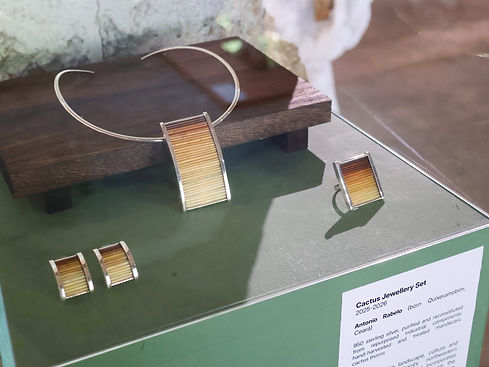
Cactus Jewellery Set
2025-2026
Antonio Rabelo (born Quixeramobim, Ceará)
950 sterling silver, purified and reconstituted from repurposed industrial components; hand-harvested and treated mandacaru cactus thorns
Drawing on the landscape, culture and biodiversity of Brazilʼs northeastern drylands, this jewellery set incorporates sustainably harvested thorns from the mandacaru cactus (Cereus jamacaru), an emblematic species of the Caatinga, carefully prepared by hand in the designerʼs workshop. Naturally ranging in colour from ivory white to deep black, the thorns continue to shift in hue as they interact with their environment, creating an evolving aesthetic that reflects the passage of time.
Lent by the designer


CATARINA
MINA
Photography Gleeson Paulino
Photography assistant Efraim Schroder
Model Mariana Pardinho
Straight Espera Dress
Summer 2025, Herdeiras do Futuro (Heirs of the Future)
Celina Hissa for Catarina Mina (born Fortaleza, Ceará) in collaboration with artisans from Feiticeiro, Jaguaribe, Ceará
Viscose dress with handwoven filet lace panel in 100% cotton
Filé lace has ancient roots in the Mediterranean world and was introduced to Brazil through Portuguese and Italian influences during the colonial period. Over time, the technique became closely associated with northeastern Brazil, where artisans developed a distinctive visual language characterised by bold colours and intricate geometric patterns. This dress features a handwoven filet lace panel created in collaboration with artisans from Feiticeiro, Ceará. Constructed on a hand-knotted cotton grid and filled with decorative embroidery, the piece highlights the geometric patterns, openwork structures and technical precision that characterise the craft.
Lent by the designer


Palm Kaftan
Winter 2025, Carnaúba: Tree of Life
Celina Hissa for Catarina Mina (founded in Fortaleza, Ceará) in collaboration with artisans from Maranguape, Ceará
100% linen with handcrafted Richelieu embroidery
From the collection Carnaúba: Tree of Life, this kaftan takes inspiration from one of the most emblematic species of Brazilʼs Northeast. Often referred to as the “tree of lifeˮ, the carnaúba has long served as a source of materials and income across the semi-arid region. From its leaves to its wax, every part of the palm has found practical applications, generating a wide range of craft and manufacturing traditions. The organic motifs traced through the garmentʼs handcrafted Richelieu embroidery evoke the forms of its leaves and fibres, translating the structure of the tree into textile language.
Developed in collaboration with artisans from Maranguape, Ceará, the piece showcases Richelieu work, a form of white cutwork lace popularised in 16th-century Europe and introduced to northeastern Brazil through colonial trade and religious networks. By mid-20th century, the technique had become an important source of income for artisan communities across the region.
Lent by the designer
Laje Earrings and Cap
Summer 2025, Herdeiras do Futuro (Heirs of the Future)
Celina Hissa for Catarina Mina (born Fortaleza, Ceará) in collaboration with artisans from Rio Grande do Norte
Handcrafted sisal fibre
Created from hand-braided sisal fibre, these earrings and cap are the result of a collaboration between Catarina Mina and artisan women from Rio Grande do Norte state. Both pieces employ a braided stitch technique that lends lightness, flexibility and intricate surface detail to the fibre.The earrings are composed of five small leaf-shaped elements joined together, while the cap transforms the same material into a sculptural accessory with a finely textured woven surface.
Through this collaboration, Celina Hissa extends her network of artisan partnerships beyond her native Ceará, fostering connections across northeastern Brazil through shared knowledge, materials and craft traditions.
Lent by the designer


ELIS CARDIM
Photography Gleeson Paulino
Photography assistant Efraim Schroder
Model Mariana Pardinho
Trama Viva (Living Weave) Dress
2026, from the Trama Viva Collection
Elis Cardim (born Salvador, Bahia)
Hand-woven and crocheted sisal from Valente, Bahia, combined with repurposed textured silk threads and recycled-blend yarn; vegetable-dyed with eucalyptus and pine, hand-embroidered
Developed as part of a research and educational initiative with Bahia Crafts and Master Zé Lito, this piece aims to elevate manual weaving into a contemporary creative language.
The silhouette is inspired by the natural intelligence and structural strength of the Caatinga biome. By combining rugged regional sisal with delicate discarded silk threads, Cardim bridges the gap between rusticity and luxury. The garment celebrates the living memory of weaving techniques that continue to be practised in Brazilʼs semi-arid communities.
Lent by the designer


ESPEDITO SELEIRO
Vaqueiro Ensemble
2026
Master Espedito Seleiro (born Arneiroz, Ceará; lives and works Nova Olinda, Ceará)
Handcrafted goat leather with natural tanning and traditional decorative leatherwork techniques
Crafted especially for Caatinga: Stitching Resilience, this ensemble was made by master leather artisan Espedito Seleiro, whose workshop brings together around forty members of his extended family. Crafted from naturally tanned goat leather, the outfit draws on the historic dress of the vaqueiro, the cattle herder of Brazilʼs semi-arid Northeast, whose protective clothing evolved to withstand the thorny vegetation of the Caatinga. A complete vaqueiro ensemble includes the gibão (jacket), peitoral (chest protector), perneiras (leggings), gloves, hat with an adjustable chin strap (barbicha), and boots, forming a distinctive silhouette shaped by the demands of working on horseback through dense scrubland.
Espedito is part of a renowned lineage of leatherworkers. His grandfather, José Francisco, made sandals for the cangaceiro Lampião, whose distinctive squared soles were designed to confuse pursuers by obscuring the direction of travel. The decorative arabesque patterns that characterise Espeditoʼs work reflect visual traditions shaped by centuries of cultural exchange, including Moorish influences that became embedded in the decorative arts of the sertão. Traditionally executed in two contrasting colours and embellished with stitched and perforated motifs, his leatherwork has become one of the most recognisable visual languages of northeastern Brazil.
The cultural importance of leather in the region was such that, during the eighteenth century, the sertão became known as the “Kingdom of the Leather-Clad Menˮ. This legacy continues to be celebrated today, notably on 20 July, Brazilʼs National Vaqueiro Day.
Lent by the maker


FLAVIA
ARANHA
Photography Gleeson Paulino
Photography assistant Efraim Schroder
Model Mariana Pardinho
Desabrochar em Si Mesmo (Blooming Within) Coat and Sandals
Summer 2026, Floresta Vive, Tudo Respira (The Forest Lives, Everything Breathes Collection)
Recreated for BCFT 2026: Caatinga - Stitching Resilience
Flavia Aranha (born Campinas, São Paulo)
100% organic brown cotton from the Rede Borborema de Agroecologia (Paraíba); chrome-free vegetable-tanned leather sandals by Arteza (Cabaceiras, Paraíba), with organic cotton appliqué
Central to Flavia Aranhaʼs practice is the creation of garments that reconnect fashion to the ecosystems, materials and communities from which it emerges. This extraordinary coat is hand-assembled from flower-shaped cotton fru-fru appliqués. The organic cotton is sourced through a partnership with the Rede Borborema de Agroecologia, a network of family farmers working within the Caatinga biome in Paraíba. Established in 2021, the collaboration enables Flavia Aranha and her team to trace the materialʼs journey from the planting of the first seed to the hand-harvested cotton fibre. Paired with chrome-free leather sandals crafted by artisans in Cabaceiras, Paraíba, and tanned using vegetable tannins rather than heavy metals, this look reflects the designerʼs commitment to regenerative material practices and local craft networks rooted in Brazilʼs semi-arid Northeast.
Lent by the designer


Canaletas Ensemble
Summer 2026, Floresta Vive, Tudo Respira (The Forest Lives, Everything Breathes Collection)
Flavia Aranha
100% silk georgette produced through family-based organic sericulture in Brazilʼs Vale da Seda; botanical print using cashew leaves and barbatimão bark collected in Bahia and Piauí; chrome-free vegetable-tanned leather sandals by Arteza (Cabaceiras, Paraíba)
Known for her research into natural dyeing and plant-based colouration, Flavia Aranha creates garments that connect fashion to local ecosystems and craft traditions. This asymmetrical top and trouser ensemble is constructed through moulage and adjustable drawstrings that create shifting volumes and drape. The silk is printed using Flavia Aranhaʼs botanical printing technique, which transfers the pigments of cashew leaves and barbatimão - plants closely associated with the Caatinga landscape - directly onto the fabric. The sandals combine chrome-free vegetable-tanned leather from Arteza, a cooperative of artisans and leather workers in Cabaceiras, Paraíba, with hand-applied fru-fru detailing in botanically printed silk georgette. Through natural dyeing, organic fibres and regionally sourced botanical materials, the ensemble highlights the ecological knowledge and biodiversity of Brazilʼs semi-arid regions.
Lent by the designer

FOZ
Photography Gleeson Paulino
Photography assistant Efraim Schroder
Model Mariana Pardinho
Lourdes Dress
2026, from the Povoado Poesia (Village of Poetry) Collection
Specially adapted for BCFT 2026: Caatinga - Stitching Resilience
Antonio Castro for Foz (born Maceió, Alagoas)
100% cotton dress with hand-embroidered redendê lace by the embroiderers of Entremontes, Piranhas, Alagoas
Antonio Castro reinterprets ancestral Brazilian textile traditions through contemporary fashion, working closely with artisan communities across the country. This dress draws on the textile traditions of Entremontes, a community of embroiderers in the district of Piranhas, in the Alto Sertão of Alagoas. Hand-embroidered in the redendê technique by the local artisans, a tradition influenced by Hardanger embroidery and preserved across generations of Brazilian needleworkers, the piece incorporates motifs
inspired by the Caatinga landscape, including spiders, snails, stars, cochado and rubaiá. Conceived as the first bridal dress by Foz, it celebrates the cultural heritage of Brazilʼs Northeast while highlighting the intimate relationship between craftsmanship, territory and memory.
Lent by the designer


GUSTAVO
SILVESTRE
Photography Gleeson Paulino
Photography assistant Efraim Schroder
Model Mariana Pardinho
Carnaúba and Buriti Dress
2026
Gustavo Silvestre (born Recife, Pernambuco)
100% hand-crocheted carnaúba and buriti palm fibres
Hand-crocheted entirely from fibres extracted from the carnaúba and buriti palms, this dress transforms materials more commonly associated with basketry and weaving into a complex textile structure. Created through a month of intensive manual work, the garment incorporates approximately 4 kg of carnaúba fibre and 2 kg of buriti fibre. These resilient plants are native to the Caatinga and have sustained indigenous and rural craft traditions for generations despite the harsh climate. Silvestre co-crafted the piece with three artisans from his Projeto Ponto Firme
initiative, including a man who learnt the craft while in prison, and women overcoming social vulnerability. The piece highlights how the meticulous rhythm of manual making serves as a tool for rehabilitation, economic independence, and creating new opportunities for people facing social and economic barriers.
Lent by the designer


GUTO
CARVALHONETO
Photography Gleeson Paulino
Photography assistant Efraim Schroder
Model Mariana Pardinho
Arribaçã Poncho
2025–2026
Guto Carvalhoneto (born Paulo Afonso, Bahia)
Handwoven 100% organic cotton by Iza Pereira and Rosa Martins of the Associação de Tecelãs da Caatinga Baiana; 100% silk lining
Born in the sertão of Bahia, Guto Carvalhoneto draws on the landscapes, materials and cultural memory of the Caatinga in his multidisciplinary practice. Inspired by the arribaçã, a migratory dove long associated with Brazilʼs semi-arid Northeast, this poncho translates the birdʼs silhouette
and flight into textile form. The fabric is woven by hand on century-old looms by Iza Pereira and Rosa Martins of the Associação de Tecelãs da Caatinga Baiana, preserving ancestral weaving knowledge passed down through generations. Combining rustic organic cotton with contemporary artistic interventions, the piece reflects the histories, rhythms and material culture of the region.
Lent by the designer


INSTITUTO
RENATO IMBROSI
Photography Gleeson Paulino
Photography assistant Efraim Schroder
Model Mariana Pardinho
Self-Portraits
2024-2026, Paraíba Meu Amor Project
Renato Imbroisi (born Rio de Janeiro) in collaboration with 126 lace-makers from the Cariri, region of Paraíba
Renaissance lace; cotton thread and cotton lacê tape
This panel was created as part of the Paraíba Meu Amor project and brings together self-portraits made by 126 lace-makers from the communities of Camalaú, Monteiro, São João do Tigre, Umbuzeiro and Zabelê in Paraíba's Cariri region. Traditionally associated with geometric and floral motifs, Renaissance lace is a needle-lace tradition introduced to northeastern Brazil at the beginning of the 20th century and preserved through generations of women artisans. Here, the technique is reimagined as a tool of self-representation, with each artisan depicting her own image through lace. Together, the portraits form a collective record of identity, memory and resilience, reaffirming the central role of women artisans in the cultural and economic life of the sertão.
Lent by the designer


MARINA BITU
Photography Gleeson Paulino
Photography assistant Efraim Schroder
Model Mariana Pardinho
Straw Sequin Dress
Summer 2026
Marina Bitu (born Fortaleza, Ceará) in collaboration with researcher Nayane Araújo (born Crato, Ceará)
Silk from the Brazilian textile industry (Petrópolis, Rio de Janeiro); biodegradable sequins made from gelatin, glycerol and coconut straw, developed in Crato, Ceará
This dress showcases an experimental textile surface developed through research into biodegradable materials derived from plant-based resources. The hand-applied rectangular sequins are made from biodegradable polymers created by researcher Nayane Araújo as part of an investigation into alternatives to conventional synthetic embellishments. Combined with silk, the material produces a distinctive texture and subtle luminosity while demonstrating new
possibilities for integrating bio-based materials into contemporary fashion design.
Lent by the designer



Reisado Leather Top and Skirt
Summer 2026
Marina Bitu
Goat leather from Arteza Cooperative, Cabaceiras, Paraíba
Inspired by the costumes worn in Reisado, a traditional folk festival of northeastern Brazil, this ensemble transforms goat leather into a fluid and highly tactile textile surface. Hundreds of narrow strips are cut and
applied by hand, creating movement that shifts with the body and recalls the dynamic presence of dances and performers. The leather is sourced from the Arteza Cooperative in Cabaceiras, Paraíba, a region internationally recognised for its long association with goat husbandry and leather production. Prepared using vegetable tanning, natural oils and manual finishing techniques, the material combines suppleness and durability. Through texture, movement and construction, the piece reimagines leather as an expressive medium for contemporary fashion.
Lent by the designer

MATRONA
Photography Gleeson Paulino
Photography assistant Efraim Schroder
Model Mariana Pardinho
Seed of Memory: The Future Harvested in the Sertão Bag Series
2025–2026
Fabiana Lopes for Matrona (born Solonópole, Ceará)
Carnaúba palm straw, buriti palm fibre, clay cactus elements, labyrinth lace, ecological cotton thread, cotton fabric and reused wood; created in collaboration with artisans from Ceará
This series of three bags explores the creative possibilities of materials closely associated with Brazilʼs semi-arid Northeast. Handwoven carnaúba straw forms the structural basis of each piece, while distinct handcrafted elements give each bag its individual character. Broto features a sculpted clay cactus; Caatinga Verde incorporates a flower woven from buriti palm fibre; and Amuleto combines a clay cactus with a linen panel framed by labyrinth lace. Bringing together basketry, clay modelling, lace-making and
textile techniques, the series demonstrates how materials from different craft traditions can be combined to create richly textured contemporary objects.
Lent by the designer


MATULÃO
Carnaúba Bags
2025
Estúdio Matulão (founded Maracanaú, Ceará)
Carnaúba straw, leather and reclaimed wood
This collection takes the carnaúba palm as its starting point. Often referred to as the “tree of lifeˮ for its many uses, the carnaúba provides fibres used in weaving and craft production throughout the region. Here, handwoven straw is combined with leather and reclaimed wood, bringing together materials that have long shaped everyday objects and artisanal production in the sertão.
The collection reflects the studioʼs understated approach to design, defined by clean lines, natural textures and careful craftsmanship. Founded by Leonardo Mota Moreira, Estúdio Matulão explores materials closely associated with Brazilʼs semi-arid Northeast.
Lent by the designer


MELK Z-DA
Photography Gleeson Paulino
Photography assistant Efraim Schroder
Model Mariana Pardinho
Cestaria (Basketry) Dress
Summer 2027
Melk ZDa (born Nazaré da Mata, Pernambuco) in collaboration with the Mulheres de Argila (Women of Clay) Collective (Recife and Caruaru, Pernambuco)
Hand-loomed 100% cotton denim selvedge waste
Fashion designer and textile artist Melk ZDa combines moulage and traditional hand-looming techniques to transform textile waste into highly crafted garments that bridge contemporary fashion and artisanal knowledge. The geometric weave draws inspiration from the basketry
traditions (cestaria) of the Caatinga region of Pernambuco. Each metre of fabric requires approximately 30 hours of intensive manual work by the women artisans of the Mulheres de Argila collective.
Lent by the designer


PATU
Photography Gleeson Paulino
Photography assistant Efraim Schroder
Model Mariana Pardinho
Celestina Corset and Zé Félix Trousers
Winter 2026
Diana Carla and Marina Fontanari for Patú (Ceará)
100% recycled cotton developed through textile defibration; naturally dyed with aroeira bark; clay buttons
This ensemble reinterprets elements of the traditional attire worn by the vaqueiro, the cattle herder of Brazilʼs semi-arid Northeast. The voluminous trousers draw on the generous proportions of garments designed for movement through the thorny vegetation of the Caatinga, while the corset transforms these references into a sculptural silhouette. The fabric was produced through a textile defibration process developed in partnership with Beatriz Têxtil S.A., in which discarded fabrics and yarns are recycled and
restructured into new cotton fibres. Naturally dyed with aroeira bark, the garments are finished with hand-made clay buttons inspired by the cracked surface of dry earth and embroidery featuring passages from O Sertanejo, José de Alencarʼs celebrated novel of the Brazilian hinterland.
Lent by the designer


RONALDO FRAGA
Groomsʼ Wedding Ensemble
2025–2026
Ronaldo Fraga (born Belo Horizonte, Minas Gerais); bespoke sandals designed and handcrafted by Espedito Seleiro.
Renaissance lace handcrafted by the lace-makers' collective of Monteiro, Paraíba; 100% cotton.
Designed by Ronaldo Fraga for his own wedding, this set of outfits was created in collaboration with eight lace-makers from Monteiro, Paraíba, over a period of six months. Made entirely from Renaissance lace, the garments bring a textile tradition more commonly associated with womenʼs clothing and bridal trousseaux to the forefront of menswear. Composed of interconnected tape lace joined by an intricate network of hand-sewn stitches, the lace creates a richly textured surface. The white ensemble is distinguished by an oversized red heart applied across the back, introducing a bold graphic gesture and an unmistakable reference to the occasion for which the garments were created. By adapting the technique for relaxed,
loose-fitting menswear, Fraga reimagines its potential while highlighting the lace's complexity and refinement. The ensembles were completed with sandals specially commissioned from master leatherworker Espedito Seleiro for the occasion.
Lent by the designer


SERTÃO ENCANTADO
Xô Boi Sandals
2026
Julia Maria Maranhão Nogueira for Ser'tão Encantado (born Maceió, Alagoas)
Naturally tanned goat leather from Cabaceiras, Paraíba; hand-painted with water-based pigments
These sandals are inspired by a style of leather footwear traditionally worn by vaqueiros (cowboys) and sertanejos (people of the sertão) across Brazilʼs semi-arid Northeast. Designed to protect the feet from thorny vegetation and rough terrain, the sandals became an essential part of daily life in the Caatinga, where durability and comfort are highly valued. Crafted from naturally tanned goat leather sourced from the Arteza Cooperative in Cabaceiras, Paraíba, the sandals retain the robust construction of their historical counterparts while introducing vibrant hand-painted decoration. Their name, Xô Boi (Shoo, Ox), references the world of cattle herding from which this style of footwear emerged, linking this practical item to one of the sertão's defining occupations. Once primarily associated with rural life, this sandal is now attracting a more contemporary audience.
Lent by the designer


WEIDER SILVEIRO
Photography Gleeson Paulino
Photography assistant Efraim Schroder
Model Mariana Pardinho
Upcycled Tapestry Ensemble
Summer 2024
Weider Silveiro (born Piauí) in collaboration with artisans Zolina and Maria Takeuti (São Paulo)
Handwoven tapestry on canva and top constructed using the fuxico techniques; 100% cotton selvedges from textile upcycling
Inspired by the traditional tapestries of Brazilʼs northeastern sertão, this ensemble transforms cotton selvedges recovered from textile production into richly textured woven surfaces. Created in collaboration with artisans Zolina and Maria Takeuti, descendants of Japanese immigrants in rural São Paulo state, the work incorporates sakiori, an ancient Japanese technique in which strips of discarded fabric are torn, woven and reassembled into new textiles. The tapestry is paired with a top composed of hand-made fuxicos—small gathered fabric rosettes widely used in Brazilian textile traditions—adding volume and tactile complexity to the ensemble.
Lent by the designer


ZUMDOO
Wooden Sunglasses
Summer 2026
Edielson Alves dos Santos for Zumdoo (born Ipirá, Bahia)
Reclaimed wood, recycled skateboard deck, ariri palm fibre and tattoo needle shafts
Wood has been central to Edielson dos Santosʼs work since childhood, when he began carving small objects from the soft timber of the native umburana tree using only a knife and machete. The braided ariri palm fibre references the hats traditionally worn by rural workers in the Caatinga to
shield themselves from the intense sun, while the shape of the frame is designed to minimise light entering from the sides, directing the gaze towards the horizon. Combining reclaimed wood, recycled skateboard decks and unexpected components such as tattoo needle shafts, the design
balances functionality with material experimentation and a distinctive sculptural presence. This contemporary object is shaped by close observation of the landscape and deep familiarity with wood.
Lent by the designer

